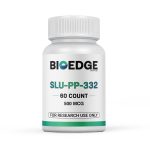
- Description
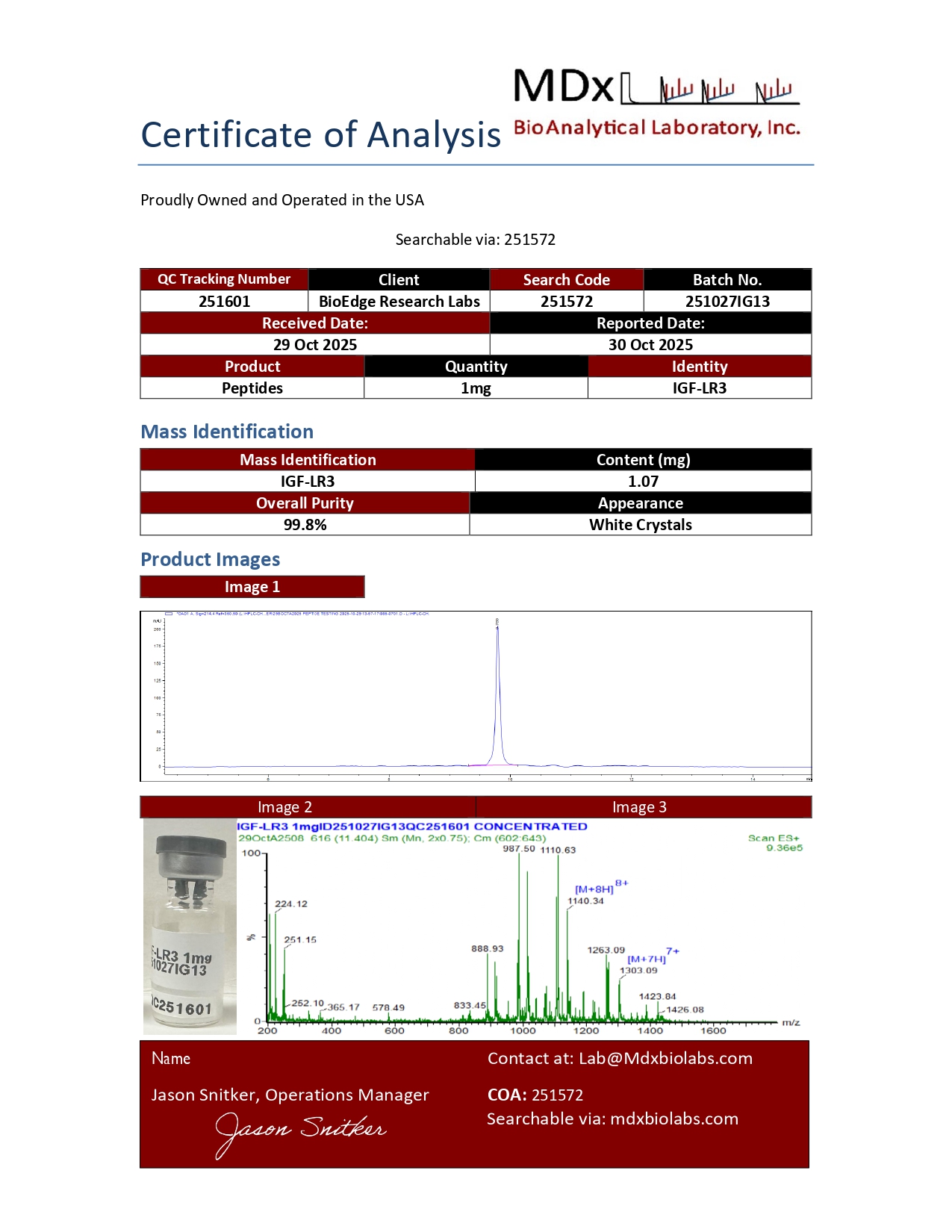
- 3rd Party Lab Testing
Description
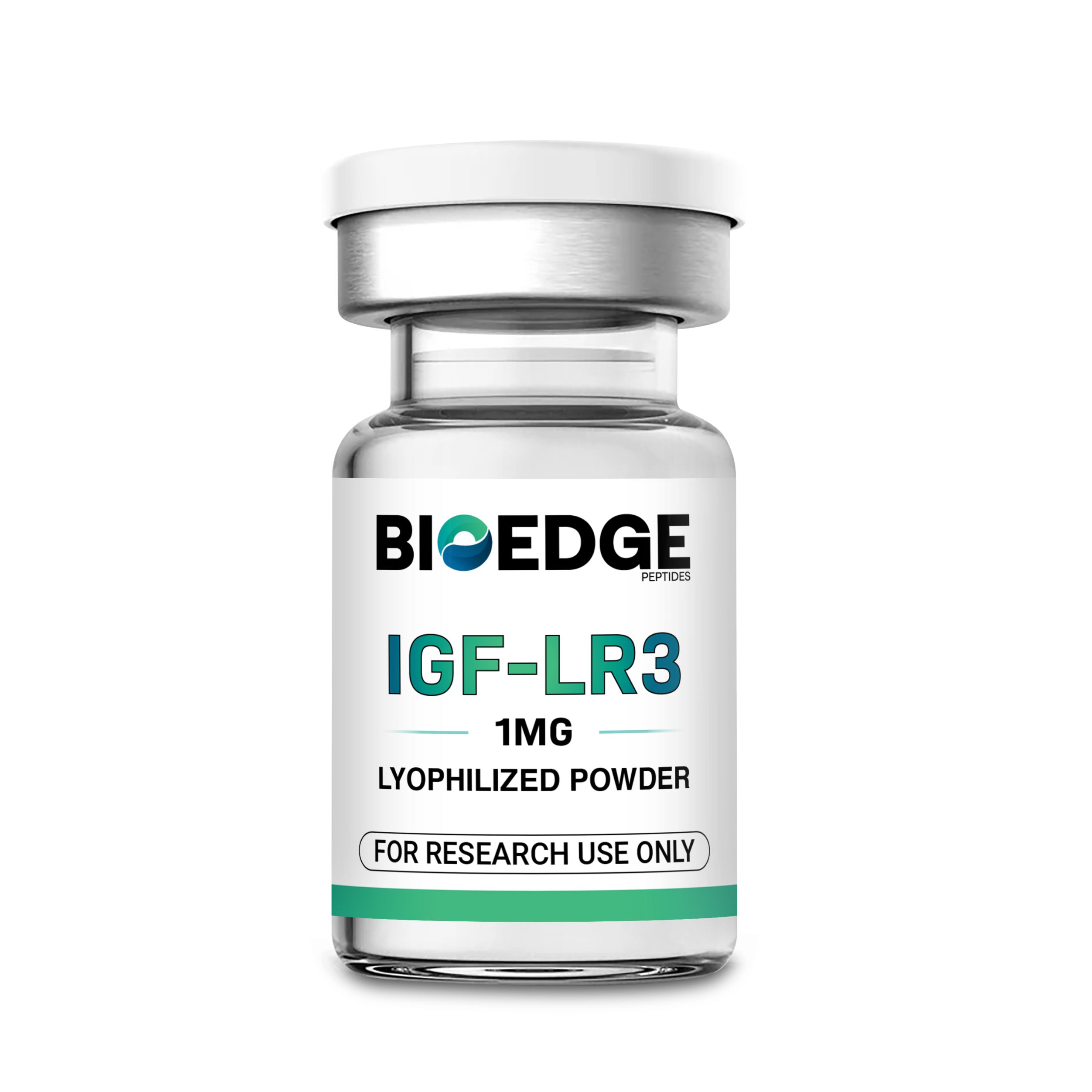
What is IGF-1 LR3?
IGF-1 LR3 (Long Arg3 Insulin-Like Growth Factor-1) is a synthetic analog of human IGF-1 designed for extended stability and bioactivity in laboratory research. The molecule contains a substitution of arginine for glutamic acid at position 3 and a 13-amino-acid extension on the N-terminus, which significantly reduces binding to IGF-binding proteins (IGFBPs) and prolongs its half-life in vitro.
In preclinical settings, IGF-1 LR3 has been investigated for its effects on cell proliferation, differentiation, and protein synthesis. Research studies have examined its influence on muscle cell growth, satellite cell activation, neuronal survival, and metabolic regulation. These investigations aim to expand understanding of IGF-1 receptor signaling and anabolic mechanisms in controlled experimental models. IGF-1 LR3 remains an investigational compound, and additional research is required to fully elucidate its biological profile.
IGF-1 LR3 Product Specifications
| Specification | Details |
|---|---|
| Purity | >99% (HPLC Verified) |
| Appearance | White Lyophilized Powder |
| Solubility | Soluble in sterile water |
| Storage Conditions | Store in a cool, dark place. If reconstituted, refrigerate immediately. |
| Stability | 24 months if properly stored |
Why Choose BioEdge Research Labs IGF-1 LR3?
-
Research Grade Purity: Verified >99% by third-party HPLC analysis
-
Secure Packaging: Designed to maintain peptide stability and prevent degradation during shipment and storage
-
Rapid Fulfillment: Most orders ship within 24 hours of payment confirmation from our U.S. facility
-
Researcher Support: Dedicated customer service tailored to licensed research professionals
Summary of Preclinical Research Findings
Muscle Growth & Protein Synthesis
IGF-1 LR3 has been widely studied for its ability to stimulate myoblast proliferation, differentiation, and protein synthesis through activation of the PI3K/Akt/mTOR signaling pathway. Research indicates it supports satellite cell activity, promotes myotube formation, and enhances anabolic signaling essential for tissue growth and regeneration.
Tendon & Connective Tissue Remodeling
Experimental data suggest IGF-1 LR3 contributes to collagen synthesis, fibroblast proliferation, and matrix organization in tendon and connective tissue models. These findings highlight its potential relevance in studying mechanisms of soft-tissue remodeling, cellular adhesion, and repair under controlled conditions.
Neuroprotection & Cellular Survival
Preclinical investigations have demonstrated that IGF-1 LR3 may enhance neuronal survival and axonal regeneration while reducing oxidative and apoptotic stress. Its activity in neuroprotection models supports research into neurogenesis, synaptic repair, and cognitive recovery following injury or degenerative processes.
Metabolic Regulation & Endocrine Function
Studies have explored IGF-1 LR3’s influence on glucose metabolism, insulin receptor cross-talk, and lipid oxidation pathways. These findings suggest potential utility in research examining cellular energy balance, endocrine signaling, and growth regulation within metabolic and aging models.
Systemic Recovery & Regenerative Research
Broader investigations of IGF-1 analogs have indicated roles in cellular resilience, wound healing, and systemic recovery models. IGF-1 LR3’s extended half-life and reduced binding to IGFBPs make it a valuable tool for exploring regenerative and anabolic processes across diverse tissue systems.
Suggested Research Applications
-
Skeletal muscle growth and differentiation models
-
Neuroregeneration and neuronal survival studies
-
Cellular metabolism and insulin signaling investigations
-
Wound healing and tissue repair modeling
-
Aging and longevity pathway analysis
-
Endocrine and receptor-binding mechanism studies
Applications listed above are intended solely for informational purposes to assist qualified researchers in experimental design. No therapeutic or diagnostic implications are expressed or implied.
Handling & Storage Guidelines
-
Store lyophilized peptide at room temperature upon arrival.
-
Once reconstituted, refrigerate immediately.
-
Use only sterile solvents appropriate for your laboratory protocol.
-
Protect from light and moisture to maintain maximum stability.
For Research Use Only
IGF-LR3 is supplied by BioEdge Research Labs exclusively for laboratory testing and in vitro research.
-
Not for human or animal use
-
Not for medical or diagnostic purposes
-
Purchase confirms that the buyer is a qualified researcher, 18 years or older
-
All usage must comply with local laws and lab safety guidelines
Summary of References
IGF-1 and Muscle Growth
-
Dunshea, F. R., Chung, S. S., Owens, P. C., Ballard, J. F., & Walton, P. E. (2002). Insulin-like growth factor-I and analogues increase growth in artificially reared neonatal pigs. British Journal of Nutrition, 87(6), 587–593. https://www.cambridge.org/core/journals/british-journal-of-nutrition/article/insulinlike-growth-factori-and-analogues-increase-growth-in-artificiallyreared-neonatal-pigs/16B8726E0FAB48940FCDF7E54A344A85
-
Florini, J. R., Ewton, D. Z., & Coolican, S. A. (1996). Growth hormone and the insulin-like growth factor system in myogenesis. Endocrine Reviews, 17(5), 481–517. https://joe.bioscientifica.com/view/journals/joe/150/1/joe_150_1_010.xml
IGF-1 and Reproductive Biology
-
Kerr, J. E., Bartke, A., & Stambaugh, R. (2001). Localization of insulin-like growth factor-I and its receptor in the reproductive tissues of male rats. Biology of Reproduction, 65(4), 1020–1028. https://academic.oup.com/biolreprod/article-abstract/65/4/1020/2723286
IGF-1 and Endocrine Regulation
-
Wang, J., Zhou, J., & Bondy, C. A. (2006). IGF-1 promotes longitudinal bone growth by stimulating chondrocyte proliferation and differentiation. Endocrinology, 147(4), 1608–1616. https://academic.oup.com/endo/article-abstract/147/4/1608/2500596
IGF-1 and Oncology Research
-
Huynh, H., Nickerson, T., Yang, X., & Pollak, M. N. (1996). Regulation of IGF-I receptor expression by the pure antiestrogen ICI 182780. Clinical Cancer Research, 2(12), 2037–2042. https://aacrjournals.org/clincancerres/article-abstract/2/12/2037/33439
IGF-1 Signaling and Cellular Models
-
Liu, J.-P. (2001). Mechanisms of cell survival signaling by the IGF-I receptor. McGill eScholarship Archive, 1(1), 1–10. https://escholarship.mcgill.ca/concern/articles/pn89db316
BioEdge Research Labs
Precision. Purity. Performance.
At BioEdge, we are committed to providing research professionals with the highest quality peptides on the market. Every compound we supply is manufactured in a cGMP-certified facility, undergoes rigorous third-party testing, and is intended strictly for in vitro or laboratory research use only.